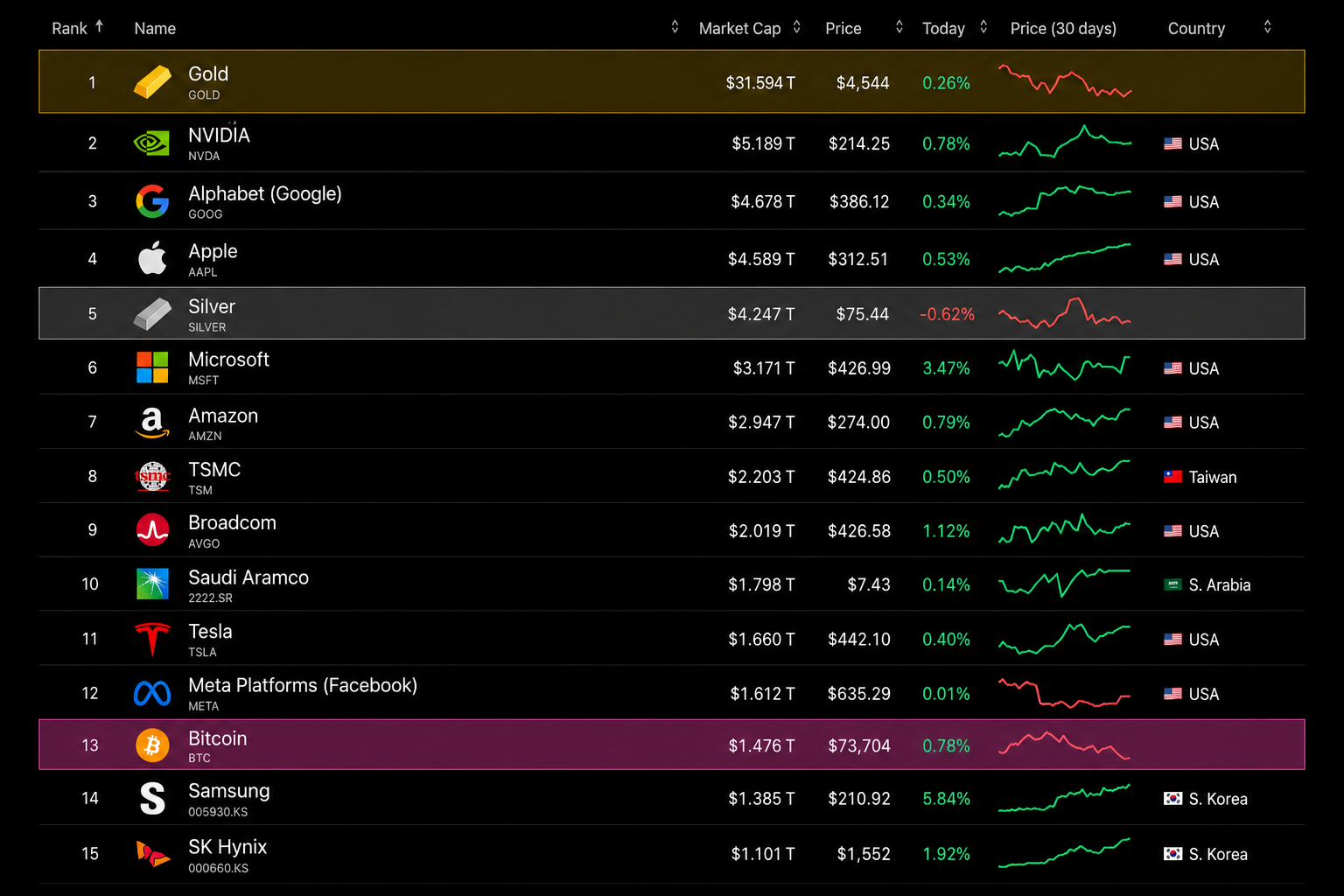
Top 15 Global Assets Ranking. Source: CompaniesMarketCap.com
Bitcoin's BTC has just lost a seat at the table with the world's most valuable assets. After a drop-down to around $72,000 on May 28, BTC's total market capitalization dropped to an estimated $1.48 trillion, pushing the asset out of the global top 10 and down to the 13th place on the CompaniesMarketCap (CMC) leaderboard, sitting behind gold, Nvidia, Apple, Alphabet, silver, Microsoft, Amazon, TSMC, Broadcom, Saudi Aramco, Tesla, and Meta Platforms.
The recent drop-down was as a result of different factors including reignited geopolitical tensions, renewed concerns over the Strait of Hormuz, and a wave of forced liquidations totalling over $933 million, with most of them being long positions. To add to the pressure, U.S spot Bitcoin ETFs recorded $733 million outflows in a single session, marking their eight consecutive days of net redemptions. With institutional buyers stepping away, there was little left to absorb the selling.
Bitcoin has now fallen roughly 11% year-to-date in 2026 and nearly 30% over the past twelve months, a stretch made worse by the fact that competing assets have done the opposite. Gold surged to a record of $5,600 per ounce in January before settling back near $4,486, while silver hit $120 per ounce and now trades around $76. Both metals have taken in significant capital as investors seek cover from macro uncertainty.
Meanwhile the assets topping the leaderboard is the AI and Semiconductor sector. TSMC and Broadcom have each crossed the $2 trillion mark in market capitalization, ranking eight and ninth globally, while Micron Technology recently became the latest chipmaker to clear the $1 trillion threshold and has gained 33% over the past year, which is an obvious contrast to Bitcoin's trajectory.
Bitcoin's correlation with Nasdaq -100 is currently at 65%, confirming that crypto trades no longer occur in isolation but are now influenced by macro forces in ways earlier cycles have never been tested.
On-chain, the picture carries its own warnings. Bitcoin has formed a death cross three times prior to 2026, with average returns of roughly -35% over the following month and -20% over three months, before historically recovering around 30% at the twelve-month mark. As of March 2026, BTC had already dropped around 50% from its record high of $126,270 set in October 2025.
Not everyone is reading this as an eminent collapse. Some traders argue that falling out of the top 10 while still holding a market cap above $1 trillion says as much about the Magnificent Seven's continued run and gold's breakout as it does about any weakness specific to crypto. The $1 trillion floor, they argue, is the real data point not the ranking.
Whether that floor holds will depend on how quickly the macro fog clears.