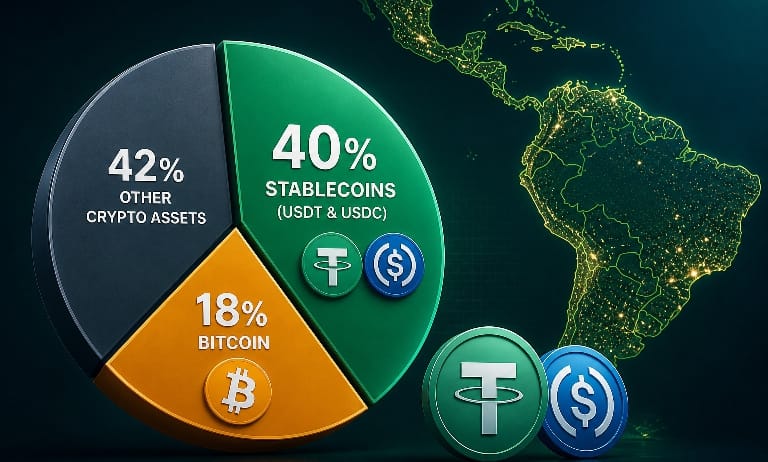
Stablecoins just surpassed Bitcoin in Latin America as the most acquired crypto purchases across the region. This basically sums up Bitso’s latest report.
According to Bitso's report, for the first time ever stablecoins primarily USDT and USDC accounted for 40% of all crypto purchases across the region, compared to just 18% for Bitcoin. The gap is enormous and translates to a reality where the average Latin America crypto user isn't betting on volatile assets to get rich, they're trying to survive inflation.
This is what Bitso calls ‘digital dollarization.’ countries like Argentina, Venezuela, and Brazil have experienced recurring bouts of currency collapse and hyperinflation over the past decade. The US dollar has always been the aspirational safe haven, but traditionally it was inaccessible without a bank account or foreign exchange controls. Stablecoins was an alternative that solved that problem. Anyone with a smartphone can now hold dollars without a US bank account, without government permission, and without the middlemen who typically eat into exchange rates.
Stablecoin use across the region is heavily driven by three main activities: preserving savings, making payments, and cross-border remittances. The remittance angle is particularly significant as Latin America receives hundreds of billions in remittances annually, and traditional wire transfers can charge fees of 5-10%. Stablecoins are cutting that cost by a margin.
The infrastructures are also catching up. Mercado Libre, Latin America's equivalent of Amazon, launched a cross-border remittance product in early April using its Meli Dollar stablecoin, connecting users in Brazil, Mexico, and Chile. When one of the continent's largest retailers integrates stablecoin rails into its ecosystem, adoption stops being a crypto theory and becomes a mainstream commerce strategy.
This isn't a Bitcoin obituary for the region. Bitcoin still sits in 52% of crypto portfolios across Latin America, essentially unchanged from the year before. It simply moved from being a transactional asset to functioning more like digital gold held long-term and not for day to day transactions.
So currently Stablecoins have won the spending battle, but Bitcoin still sits high in the savings portfolio, which is a meaningful division of labor that mirrors how the broader crypto market is adjusting.
The global stablecoin market now stands at roughly $320 billion, and Latin America's usage patterns may be the clearest real-world proof yet that stablecoins are not just crypto trading tools but becoming essential financial infrastructure for economies the traditional banking system has underserved for generations.