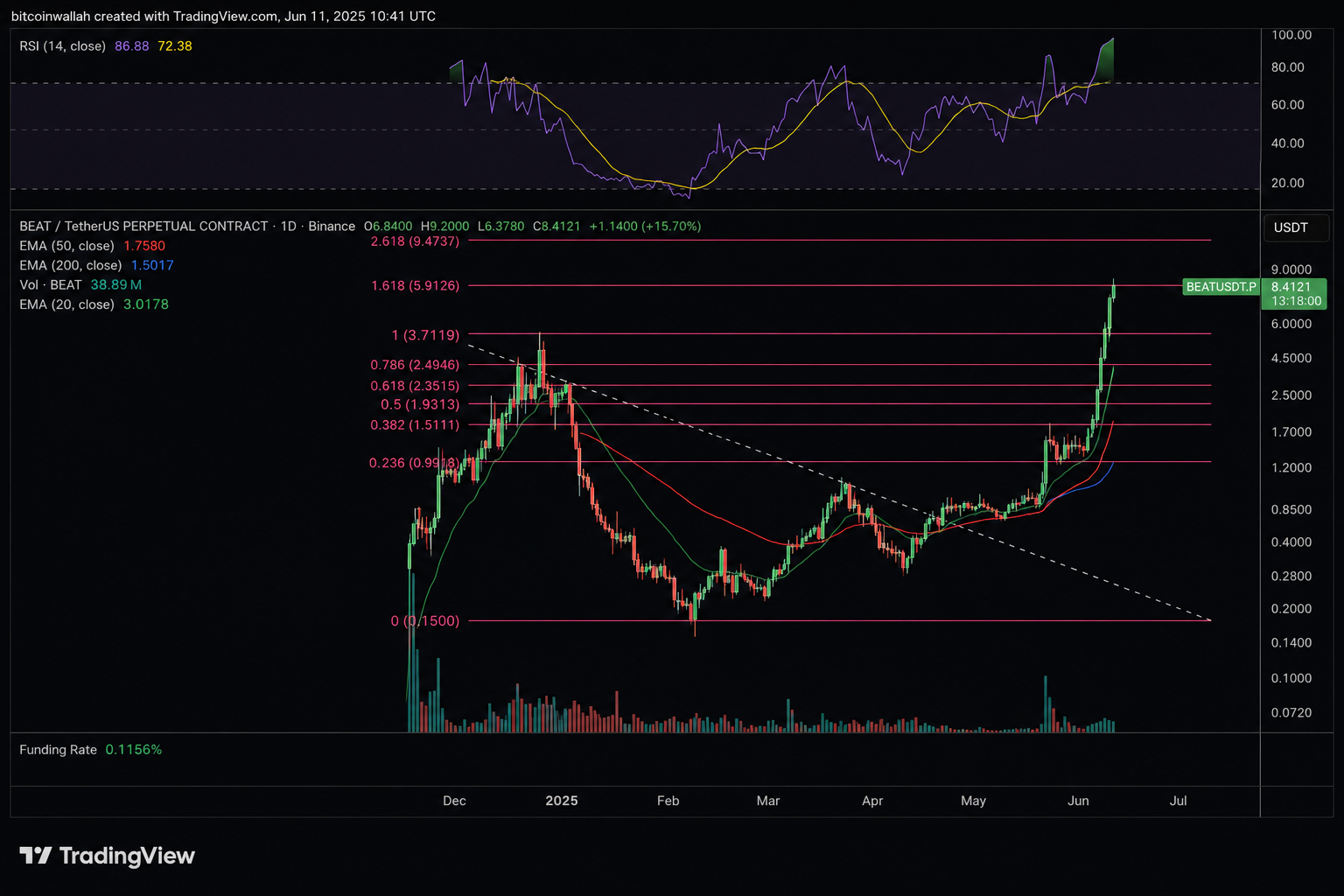
BEAT/USDT daily price chart. Source: TradingView
Audiera's BEAT token has done something almost nobody predicted, they surged from below $1 earlier in May to a record high near $9.20, a move exceeding 1,400% on the monthly timeframe while Bitcoin and Ether lost ground.
The rally has turned BEAT into one of crypto's most watched AI-linked trades. But the same data that explains the run also points out where it breaks.
Between June 1 and June 8, Audiera reported 772,045 BEAT in weekly revenue, roughly $2.87 million at the prevailing price and burned 770,545 BEAT, bringing total removed supply to 12.35 million tokens. Burns against a fixed 1 billion-token cap can tighten circulating supply when demand is climbing, and that math has given traders a clean value-capture story than most AI tokens offer.
@MasterCryptoHq, who carries 162,900 followers on X, framed it directly: "Audiera is not just a hype project. It is a Web3 dance game making over $140K in revenue every week. Part of that revenue is used to burn $BEAT tokens... Real revenue + token burns equal less supply."
The argument holds, conditionally. What it doesn't account for is that only about 288–290 million BEAT currently circulate from a maximum supply of one billion. CryptoRank shows the next scheduled unlock at 21.24 million BEAT on July 1, 2026 a date that now sits directly inside the window where overbought technicals are most dangerous.
Open interest rose approximately 35% to around $303.5 million as BEAT climbed, while over $11 million in short positions were forcibly liquidated. The combination of rising open interest and forced buybacks created a feedback loop where buying pressure was not entirely organic.
On-chain analyst @0xNox flagged the dynamic before it peaked, he posted; "In my post on May 28, I pointed out some unusual whale activity that caught my attention. Multiple long positions were being opened at the same time, seemingly to keep the price elevated. Since then, $BEAT has done a 5x in just 10 days."
He also pointed out that tokens distributed across several dormant wallets had not moved and could become selling pressure if they do. Arkham data shows the single largest holder controls 34.17% of supply.
Beyond the RSI reading of 96.87, the highest on record for the token Santiment data reveals a negative Price-DAA Divergence: Daily Active Addresses failed to keep pace with the asset's valuation, with active user engagement flattening even as price climbed. That gap between price and genuine user growth is usually the earliest structural warning ahead of a deleveraging event.
A rejection at the $9.47 Fibonacci resistance and a July 1 supply unlock arriving into peak overbought conditions is not a setup that rewards late buyers. The burn model is real and the risk above it is equally real.