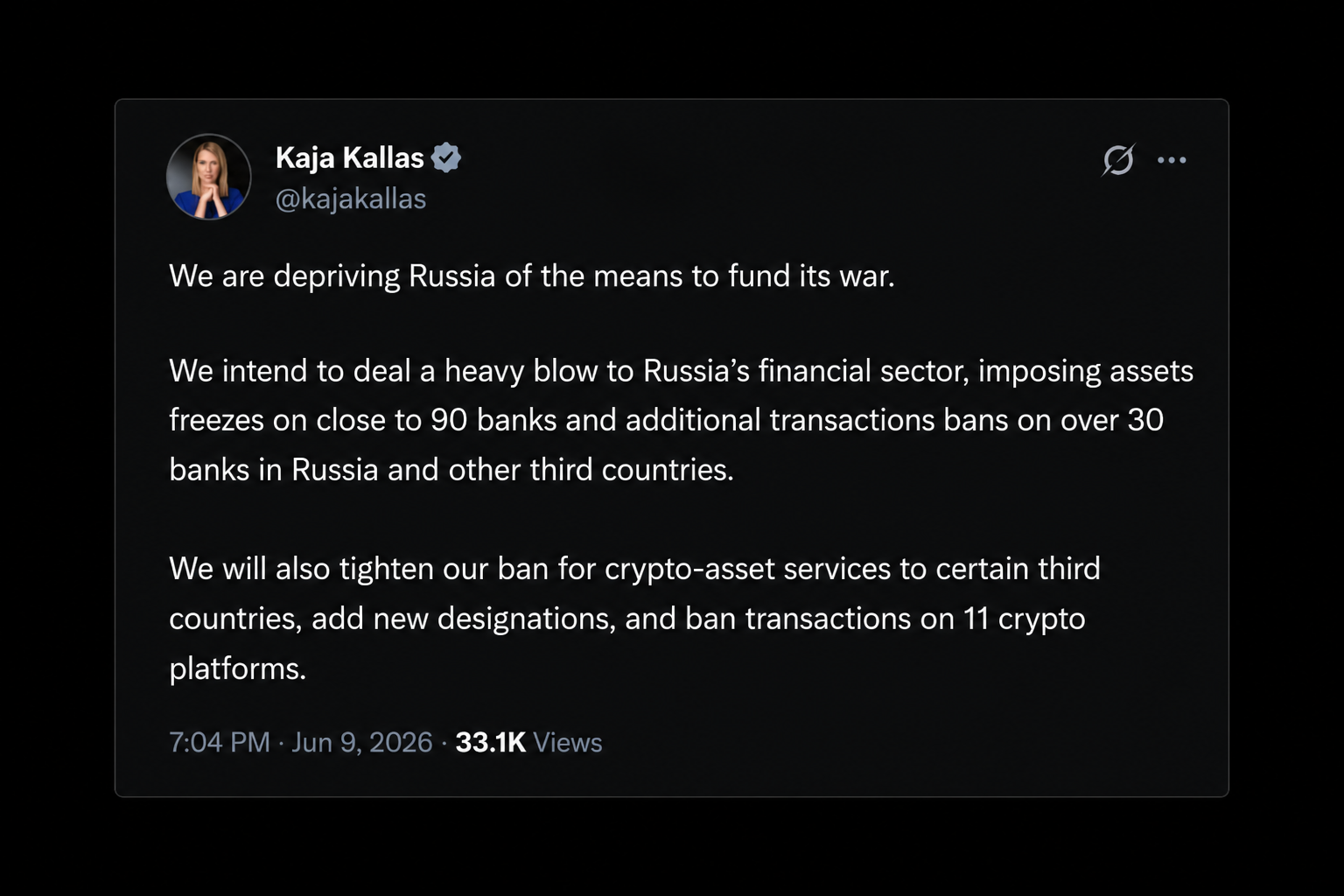
Source: Kaja Kallas Image Credit: Delogg team
The European Union has made a proposal to ban transactions on 11 crypto platforms as part of its 21st sanctions package against Russia, this was announced on the 9th of June in Brussels and for the first time, the commission is also seeking legal authority to designate an entire country's crypto sector as off-limits not just individual firms.
EU High representative Kaja Kallas confirmed the sanction package will target banks, weapons manufacturers, oil traders, refineries and crypto operators in third countries, with the commission proposing an additional transaction bans on over 30 banks in Russia and abroad. The 11 crypto platforms remain unnamed in public commission statements.
Chainalysis has described the A7A5 ruble-backed stablecoin as processing $119.7 billion to date, functioning as a purpose-built settlement rail designed to bridge sanctioned Russian businesses into the global financial system. TRM Labs ties A7A5 directly to the Garantex-to-Grinex migration, describing the token as the financial bridge between the two platforms after enforcement disrupted Garantex.
The 21st sanction package is not the first to target this infrastructure. The 20th package, adopted in April 2026 and effective May 24, also made a notable change by imposing an absolute prohibition on EU persons engaging in direct or indirect transactions with any crypto asset service provider or decentralized platform established in Russia, while also banning the RUBx stablecoin and digital ruble. Now the 21st package is extending that logic outward, to the third-country intermediaries that absorbed the traffic.
Under this newly proposed framework, the commission would have the authority to identify and label an entire jurisdiction crypto sector if that jurisdiction is found to be a consistent hosting environment for Russian sanctions evasion. Countries like Turkey, the UAE, Kazakhstan, and Hong Kong are all under the watchful eyes of the EU as major intermediary hubs.
Ellipitic noted in its analysis of recent packages that recent attempts has already been made to target systems that enable crypto sanctions evasion, rather than just individual actors and the 21st package takes that approach even further
Moscow's response arrived the same day as the Russian Deputy Finance Minister Ivan Chebeskov, speaking at SPIEF 2026, disclosed that Moscow is preparing fees and trading limits targeting USDT, USDC, and BNB assets whose issuers have previously frozen wallets tied to sanctioned addresses. The bill is expected to pass the State Duma in June and take effect July 1, 2026, with Russian retail investors restricted to trading only Bitcoin, Ethereum, and USDT under the new Digital Currency and Digital Rights Law.
The 21st package remains a proposal. It requires unanimous approval from all 27 EU member states, a process that has slowed or diluted past rounds. With Russia actively building parallel financial rails, the gap between Brussels passing packages and those packages closing evasion routes remains the central unresolved problem.