Source: Senator Cynthia Lummis Credit: Delogg Media
A group of six Republican senators sent off a letter to the country's top banking regulators last week, and the message was straightforward, it said the rules that prevent U.S. banks from holding digital assets need to go.
Senator Cynthia Lummis led the charge, joined by fellow republicans Dan Sullivan, Bill Hagerty, Bernie Moreno, Ted Budd, and Jon Husted. Their May 27 letter was submitted on the desks of three Vice Chairs, the Federal Reserve Vice Chair for Supervision, FDIC Chair, and Comptroller of the Currency, the three officials who also happened to be testifying before the House Financial Services Committee the same day the letter went public.
At the center of the dispute is a Basel Committee rule adopted in 2022. It assigns Bitcoin and similar cryptocurrencies a 1,250% risk weighting when held on a bank's balance sheet, a level critics say makes direct exposure economically not practicable.
In other words a bank holding $1 million worth of Bitcoin would have to reserve capital as if it were facing a $12.5 million exposure. The senators argue that the requirement effectively prices banks out of the market, and called this what it essentially is a "de facto ban" they also argued it has no grounding in any real-world assessment of how digital assets actually behave.
The letter did give credit where it was due. Regulators issued guidance in March clarifying that the capital treatment of tokenized securities should be based on the nature of the underlying asset, not the technology recording it. The senators want that same logic applied to crypto holdings more broadly.
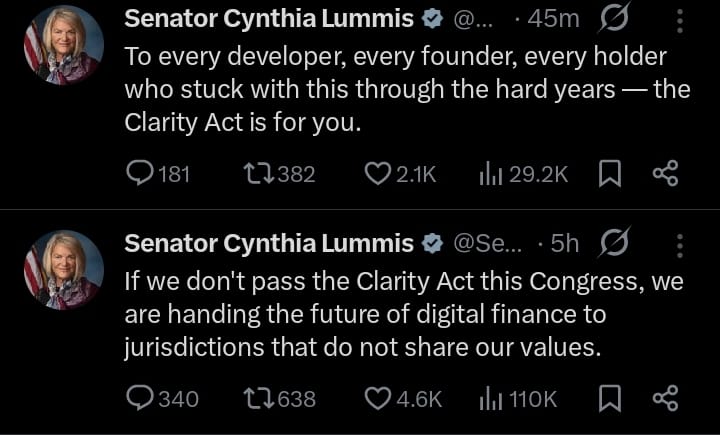
The timing is pointed. The Senate returned from recess this week and is set to resume debate on the CLARITY Act, the sweeping market structure bill that would hand banks authority to use digital assets for payments, lending, custody, and trading. Journalist Eleanor Terrett flagged the letter on X, noting it directly intersects with the CLARITY Act's trajectory.
The political clock is ticking and Senator Cynthia Lummis has been warning that the political timing may be tighter than it looks. In her view, if lawmakers fail to move major crypto legislation before the November midterms, the next realistic window could stretch far beyond the current Congress potentially even toward 2030 depending on how the Senate schedule changes.
At the center of the debate is the CLARITY Act, which faces a steep procedural step where 60 votes are needed to overcome a filibuster. That math forces Republicans to secure support from at least seven Democrats, a task that remains uncertain given the current mood on Capitol Hill. Until those gaps are closed, the bill is unlikely to move smoothly through the Senate.
Though the capital rules letter means something important, lawmakers aren't waiting for the CLARITY Act to pass before trying to change the regulatory ground beneath it. Whether regulators move before or after Congress does is now a live question.