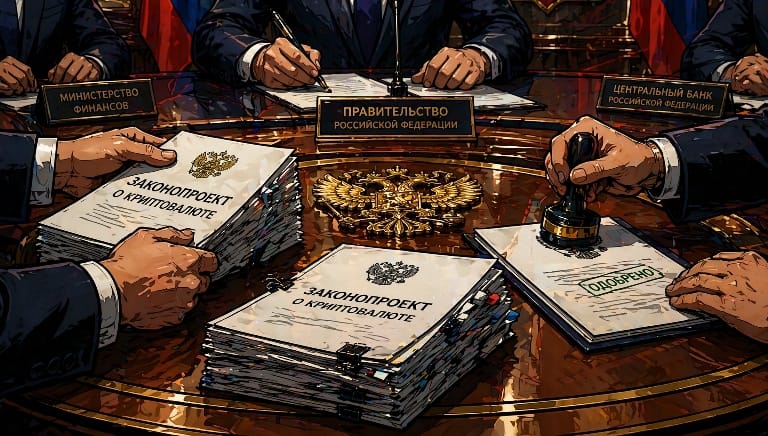
Russia's State Duma cleared its crypto regulation bill on first reading Wednesday 22nd of April 2026, moving the country close to one of the most tightly controlled digital asset regimes in the world.
The bill which was formally titled "On Digital Currency and Digital Rights" would now legalize crypto currencies in Russia while making the Central Bank the country's primary regulatory authority, responsible for issuing licenses, approving transactions, and determining what is and isn't legal in the market.
The dual nature of the legislation is worth paying attention to. Cryptocurrency would be recognized as property under the bill, meaning crypto assets could be protected in court, including in bankruptcy and divorce proceedings. But it simultaneously bans crypto from being used as a means of payment for goods and services inside the country,while pointing out a specific exception for cross-border trade and foreign settlements. That exemption is not accidental as Russia has been privately testing crypto for international payments as a workaround to Western sanctions.
In other words, the legislation recognizes crypto as property, to open a door for cross-border trade, but closes it on anyone running an unlicensed exchange.
The criminal enforcement layer is where the consequences for defiling the order comes from. A new article, Article 171.7 would be added to the Criminal Code, making it a crime to organize digital currency circulation without a Bank of Russia license. Standard violations carry up to four years in prison. And cases involving organized groups or damages exceeding roughly $177,000 increases the sentence for up to seven years.
Ordinary citizens would face their own restrictions being unqualified investors must pass a financial knowledge test and would be capped at roughly 300,000 rubles around $4,000 in crypto purchases per year. Only digital assets with a market cap above 5 trillion rubles with daily trading volume exceeding 1 trillion rubles, and at least five years of trading history would be permitted a threshold that currently points to Bitcoin, Ethereum, Solana, BNB, and TRON.
Not everyone in the system is comfortable with the pace. Russia's Supreme Court publicly criticized the criminal penalties as premature, noting they lack reasoned justification while the underlying digital currency law has yet to come into force. That kind of open dissatisfaction from the country's highest court is rare and signals rising tension inside the legislative process.
The bill still needs to pass second and third readings in the State Duma before moving to the Federation Council and then to the president's desk. A July 1, 2026 implementation target remains on the table.
The contradiction at the center of all of this remains hard to miss is that the same government capping its citizens at $4,000 in annual crypto purchases is the one using digital assets to route payments around international sanctions.