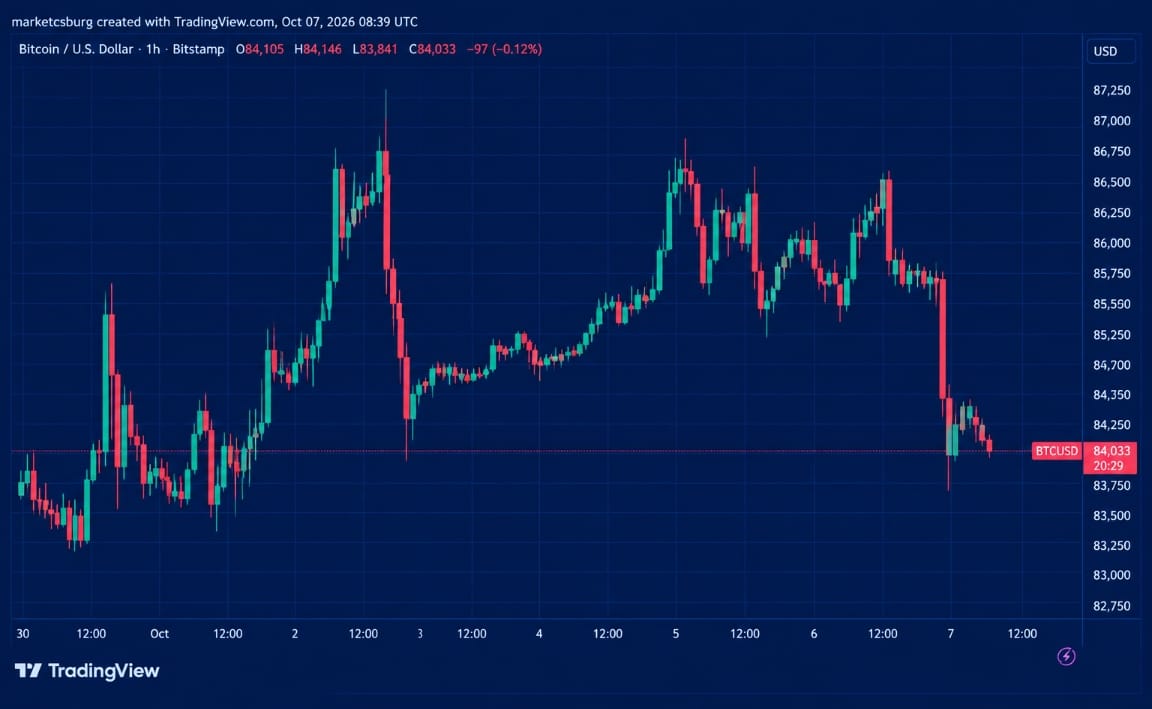
BTC/USD one-hour chart. Source: Delogg News/ TradingView
Bitcoin dipped below $84,000 late Tuesday shortly after, users noticed four newly created Hyperliquid wallets that shorted 148.49 BTC with 40x leverage. Lookonchain highlighted the trade on X with a caption “Insiders?” Maybe.
For starters, the size of the trade was the giveaway as the wallets put in $1 million in USDC and ended up holding around $12.5 million in exposure. So while the position was labelled 40x, they were actually sitting at something closer to 12.5x based on the money they put up.
CoinGlass recorded $555.6 million in liquidations over the same 24 hours. Those four shorts made up for roughly 2% of that, which was not enough to steer the whole market on its own. The wallets may have timed the right time for the trade, but the size of the position suggests they were reacting to the move rather than causing it.
Considering the timing, the trade starts to look like less of a suspect because Hyperliquid's public data, as reported by Unchained, showed that the four wallets opened their shorts between 8:04 and 8:17 p.m. ET, was averaging an entry sitting around an estimated 85,500. Bitcoin, on the other hand, was still hovering around $85,300 until roughly 9:50 p.m., when the slide really began. It then fell to about $83,550 by 10:05.
That means the wallets were already positioned almost 90 minutes before Bitcoin started making its move. Early reports estimated that they were sitting on paper profits of between $220,000 and $235,000. The timing was certainly good, but being first doesn't guarantee they knew the drop was coming.
Afterwards CoinGlass data cited by The Block shows that $429.8 million in liquidations came in within just four hours. Across the full 24-hour period, longs accounted for $487.2 million of the liquidations. In other words, a lot of leveraged positions were being forced out at once.
Dominick John of Zeus Research said the buildup in open interest and funding rates had already left the market vulnerable to that kind of deleveraging. Ether got hit even harder, dropping about 3.3% to around $2,610, while the Fear & Greed Index fell from 67 to 62.
There was still another side to the story, though. Jeff Ko, chief analyst at ViaBTC, pointed to Bitcoin's roughly 40% gain for the third quarter and the $6.5 billion that flowed into spot ETFs during the period. His view was that the $82,000 to $83,000 range could be the level to watch. If Bitcoin holds there, the drop could end up looking more like consolidation than the start of another major sell-off.
For traders, the interesting part isn't necessarily those four Hyperliquid. The shorts were public, so everyone could see them. What wasn't as obvious was the amount of leverage sitting on the other side. Bitcoin had already been struggling around $87,000, and plenty of traders were still positioned for it to break higher. Once that failed, the crowded long side had very little room to absorb another move down.