The United States government currently controls roughly $21 billion worth of Bitcoin. It didn’t accumulate this position by buying on the open market or mining coins. Historically, U.S. Bitcoin holdings have accumulated through criminal and civil asset forfeiture with cases tied to major fraud, ransomware, and darknet investigations. Though the Department of Justice notes that seized cryptocurrency is treated as government property and typically held or auctioned following court proceedings, not actively traded or accumulated as a reserve. Public court filings show that at least 127,000 BTC held from a single forfeiture case, while blockchain data suggests additional holdings from earlier seizures.
TRUMP SIGNS THE ORDER AND BITCOIN IMMEDIATELY DROPS
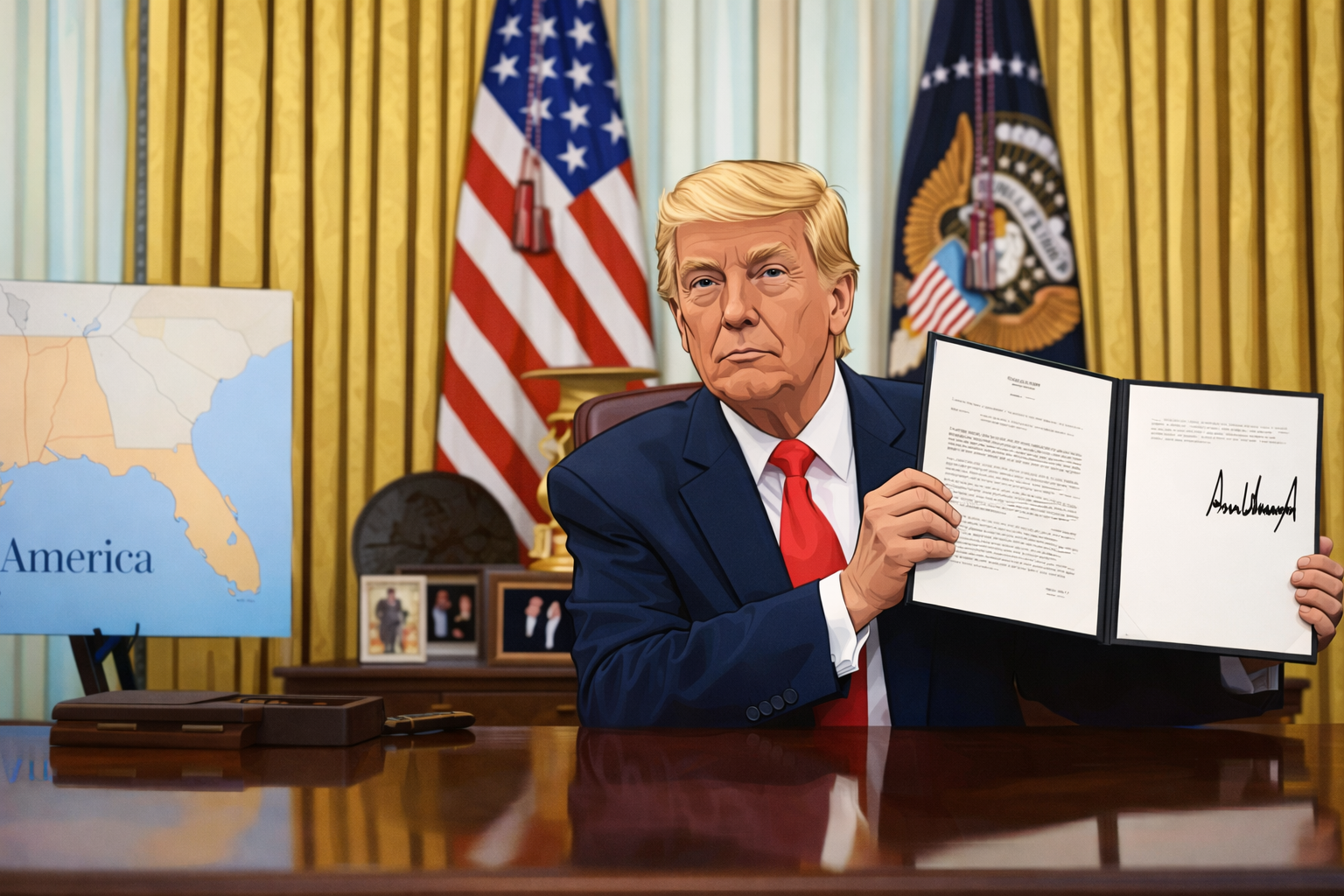
On March 6, 2025, President Donald Trump signed Executive Order 14233, formally creating a Strategic Bitcoin Reserve and a broader U.S Digital Asset Stockpile. For the first time Bitcoin was officially announced as a national asset and conceptually grouped alongside America's gold reserves and petroleum stockpiles.
This caused a Market uproar, immediately plunging Bitcoin and marking the event as one of the most historic in the timeline, but a year later, and the situation is even more complicated than it first appeared, with questions brewing up like never before. How exactly did the government end up with all of this in the first place?
HOW A DECADE OF CRIME BUILT AMERICA'S LARGEST BITCOIN POSITION
The answer lies in some of the most significant criminal cases in cryptocurrency’s history. It starts with Silk Road, a darknet market place that operated between 2011 and 2013, where illicit goods and drugs were traded almost exclusively in Bitcoin. The FBI shut it down in 2013 and arrested its founder Ross Ulbricht and this process marked the government's first significant accumulation of Bitcoin holdings through forfeiture. The first batch which was 29,657 Bitcoin was auctioned in June 2014 for $17.4 million. By the time the Silk Road auctions concluded, 144,336 Bitcoin had been sold for a combined $48.2 million. At Bitcoin 2025 peak, those same coins would have been worth over $17 billion. The cases kept coming. In February 2022, the Department of Justice announced the seizure of approximately $3.6 billion in Bitcoin linked to the 2016 Bitfinex hack, where hackers stole 119,754 BTC from Bitfinex in one of the largest exchange thefts in crypto history, 94,643 BTC was recovered, at the time it was recorded as the largest cryptocurrency seizure in Department of Justice history. The coins traced to IIya Lichtenstein and Heather Morgan, this seizure was largely untouched for years while Bitcoin's value climbed. Later that same year, IRS Criminal investigation seized 50,676 Bitcoin from James Zhong, a Georgia man who exploited a flaw in Silk Road's withdrawal system back in 2012, initiating over 140 transactions in rapid succession to steal nearly 50,000 coins for almost a decade before investigators tracked him down. Each of these cases added to a growing, uncoordinated pile of digital assets scattered across multiple federal agencies like the FBI, the IRS, the DEA,and the Secret Service each holding their own seized coins with no central oversight and no shared protocol for what to do with them. The executive order itself acknowledged the problem directly: “ no clear policy existed for managing these assets, leading to a lack of accountability and inadequate exploration of options to centralize, secure, or maximize their value” (Blockmanity). The Reserve was not conceived as a bold investment strategy but rather as damage control, a formal acknowledgement that the previous approach had been costly and strategically incoherent. As of February 2026, the United States holds an estimated 382,372 BTC, making it the largest state holder of Bitcoin in the world. And for the first time in the asset's history, a sitting U.S president has declared that the government intends to keep it.
WHY BITCOIN GOT TREATED DIFFERENTLY FROM EVERYTHING ELSE
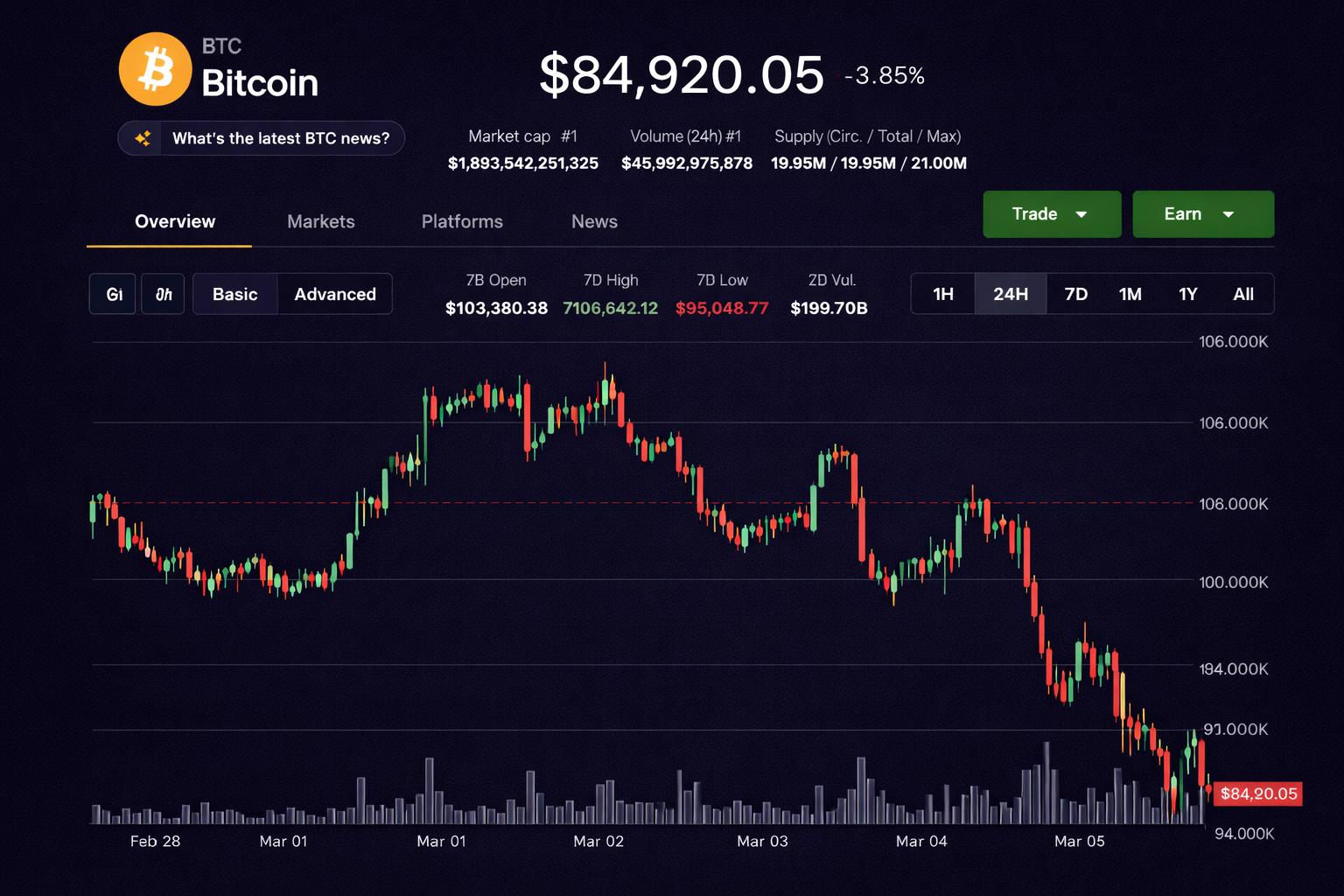
On March 3, 2025, Trump made a post on Truth Social saying he would direct the Presidential Working Group to move forward on a Crypto Strategic Reserve including Bitcoin, Ethereum, XEP, Solana, and Cardano. In that moment, Bitcoin surged from $86,000 to above $94,000 almost immediately. The altcoins named in the post had massive surges as well but three days later, the details arrived and the market read the situation more carefully. On March 6, Bitcoin fell from above $90,000 to around $84,900 within minutes of the official executive order signing because what the market had priced in was active government purchasing fresh capital, a direct demand shock and the US Treasury buying Bitcoin in the open market but what it got was a consolidation and hold policy funded entirely from Bitcoin the government had already seized, with David Sacks confirming that taxpayer money would not be used to acquire a single coin.
Charles Edwards, founder of Bitcoin-focused hedge fund Capriole Investments, called it "the most underwhelming and disappointing outcome we could have expected," arguing that without a buying plan, the strategy amounted to "a pig in lipstick." That reaction was understandable. But it may also have been shortsighted and understanding why requires actually reading what the order established.
ONE ORDER, TWO VAULTS
The executive order creates two distinct structures with two very different mandates. First, is the Strategic Bitcoin Reserve, a permanent hold on every Bitcoin the federal government currently controls and any future seizures. The instruction is absolute: do not sell, do not trade, do not liquidate. The order particularly cites Bitcoin's fixed supply of 21 million coins and it's security record as the basis for treating it differently from every other digital asset, directly comparing it to gold and positioning it as a long term store of national value. The second is the U.S Digital Asset Stockpile, a separate category for every other seized digital asset. Ethereum, XRP, Slana, and Cardano were placed here, with the government retaining the flexibility to eventually sell from this secondary stockpile, an option explicitly denied for Bitcoin. The order also encouraged government officials to seek ways to add more Bitcoin to the reserve, directing the Secretaries of Treasury and Commerce to develop budget-neutral acquisition strategies provided those strategies impose no incremental cost in american taxpayers. On the political opposition side, House Democrats were direct in their criticism. Maxine Waters, a ranking member of the House Financial Services Committee, called the reserve ‘silly’ arguing that cryptocurrency is not “an essential input that powers the U.S economy and day-to-day life for American families.” but Matt Hougan of Bitwise captured the longer view: "Did this executive order make it more likely that in the future, Bitcoin will be a geopolitically important currency or asset? Will other governments follow the U.S.'s lead and build their own strategic reserves? And to me, the answer to that is emphatically yes.”
THE LEGAL PROBLEM THAT COULD ERASE 30% OF THE RESERVE OVERNIGHT
But here is where the reserve gets complicated in a way that has not been explicitly explained. The Strategic Bitcoin Reserve currently holds approximately 328,372 BTC, worth around $21.6 billion. But roughly 94,643 of those coins, which is about 30% of the total are directly tied to the 2016 Bitfinex hack, and a pending court ruling could return them to the victims without the government selling a single coin. In January 2025, prosecutors formally asked a federal court to approve the returning if those assets to Bitfinex as in-kind restitution, meaning the Bitcoin would be returned as Bitcoin, not converted first to dollars. The executive order itself carved out an exception for exactly this scenario. While it prohibits the government from selling its Bitcoin, it simultaneously allows agencies to return assets to "identifiable and verifiable victims of crime." As restitution is not a policy choice, but a legal obligation. If the court rules in Bitfinex's favor, the reserve number on trackers falls by 30% overnight. For investors and market participants, the important clarification is if those 94,643 BTC leave government custody, it will not be a sign that the U.S is retreating from it's reserve policy. It will be a legal transfer following the exact framework the executive order laid out. The difference between restitution and a government sale is important for how the market should interpret that event if and when it happens.
THE BITCOIN ACT
The executive order was always the first step, but not the full picture as any principle it established needed to be formalized in law by the legislation. On March 11, 2025, Senator Cynthia Lummis and Congressman Nick Begich introduced the BITCOIN Act of 2025, a bill that would authorize the Treasury Department to actively purchase up to 1 million Bitcoin over a five-year period, going well beyond the seized assets only approach of the executive order. The acquisition would be funded in part through net earnings from the Federal Reserve and by issuing new gold certificates at market value, with the difference financing the Bitcoin purchase program. Any Bitcoin acquired under the act would be required to be held for a minimum of 20 years.

At current process that program would represent roughly $80 billion in acquisitions making it the largest sovereign digital asset accumulation program in history if passed. The bill currently has six senate co-sponsors, all Republicans. But it faces real obstacles as it remains a partisan effort in a narrowly divided Congress, and Senator Lummis announced in December 2025 that she will not seek reelection, removing the legislation's strongest advocate from the equation heading into 2026. However, she remains in office through 2026 and can continue to advocate for the bill this session but her departure could complicate leadership support next Congress if the bill doesn’t advance this year.
ONE EXECUTIVE ORDER IN WASHINGTON AND FOUR CONTINENT RESPONSE
The policy debate around the Strategic Bitcoin Reserve is not only about what the U.S government does with the seized coins but what it means for every other government watching. The European Central Bank responded by stating that Bitcoin will not enter reserves of any EU central bank. The managing director of the European Stability Mechanism warned publicly that the U.S. policy shift could affect the euro area's monetary sovereignty. India announced it is reviewing its position on cryptocurrency in light of the shifting global stance. Pakistan announced plans to allocate surplus electricity to Bitcoin mining. One executive order in Washington produced a policy conversation across four continents. On the domestic side the reserve overlap with a broader regulatory change. The departure of SEC Chairman Gary Gensler and the appointment of a crypto- friendly replacement has greatly changed the enforcement posture towards digital assets in the United States, this now enforces the reserve policy as part of a strategic pivot, not a one-off gesture.
CATHIE WOOD'S PODCAST, WHAT'S NEXT?
ARK Invest founder Cathie Wood argued on the Bitcoin Brainstorm podcast that the federal government may soon move beyond seized assets towards active Bitcoin purchases, and this would greatly impact market value. Wood identified three reasons behind her view: Trump does not want to finish his term as a lame duck president, his family holds significant investments in Bitcoin and crypto assets, and crypto delivered measurable political support in the 2024 election that the administration will want to maintain ahead of the 2026 midterms. Wood stated directly: "It seems as though there's been reticence about actually buying Bitcoin for the strategic reserve. So far, it's confiscated. The original intent was to own a million Bitcoin. So I actually think they will start buying." Whether that happens in 2026 depends on congressional appetite, macroeconomic conditions, and whether the BITCOIN Act or a version of it can gain the cross-party support it currently lacks. What is already established is the direction it's headed. The I.S government has moved from auctioning Bitcoin to declaring it as a permanent reserve asset in under 12 months. Regardless of what comes next in legislation this is already branded as one of the most consequential policy developments in the digital asset industry's history. Cryptocurrency recognition at the level of a U.S executive order carries weight that no corporate balance sheet or industry conference can replicate but it is not thesame as a functioning reserve infrastructure and the gap between declaration and delivery is exactly what this year would expose. The foundation had been laid. What would be built on it and how quickly is the question 2026 is about to answer. In our next article, we break down the state-level Bitcoin reserve race, who's leading, what approaches they're taking and what this would mean for Bitcoin in the year 2026.