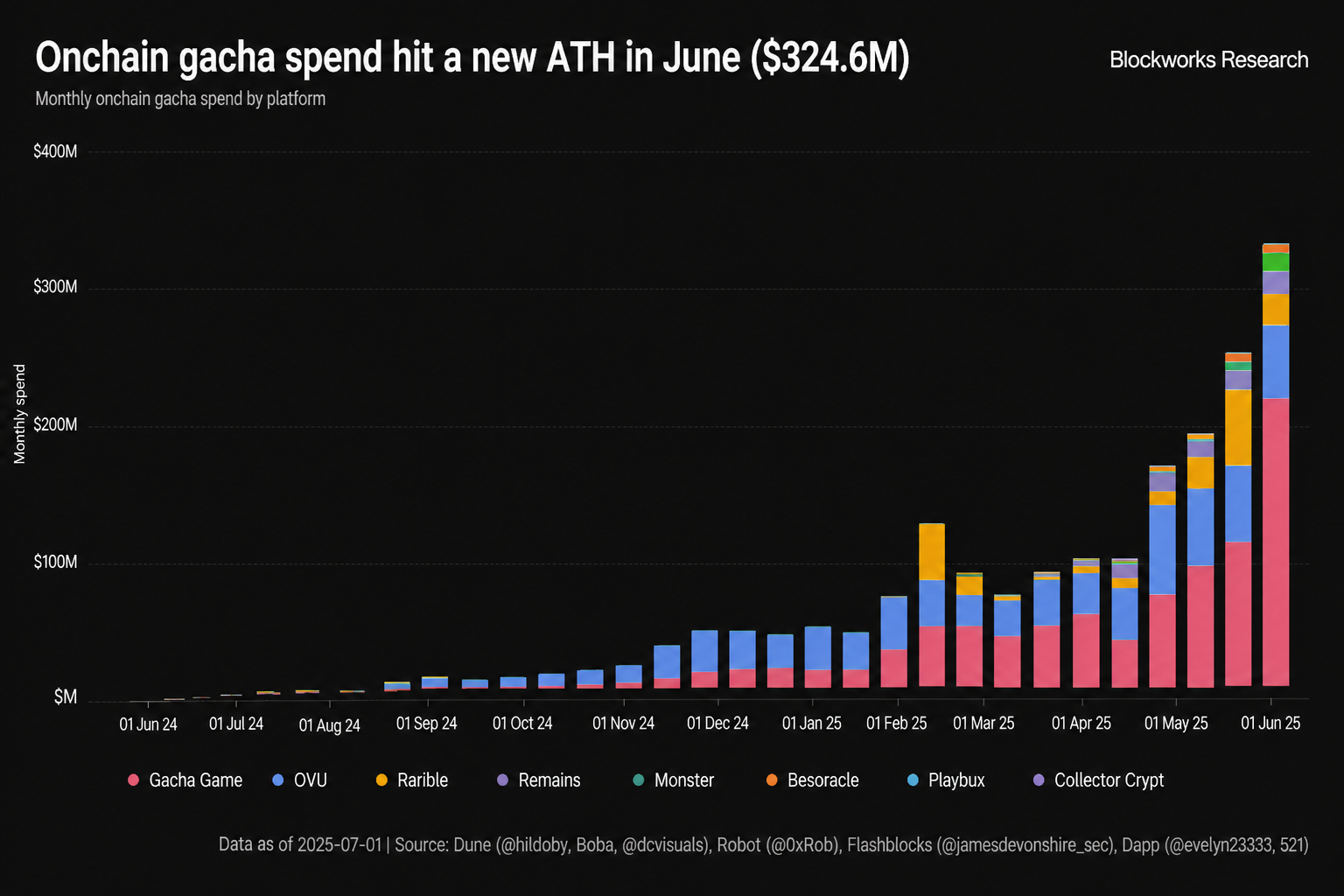
Onchain gacha spending hit an all-time high in June 2026. Source: Blockworks.
Card Collectors have spent a record $324.6 million on on-chain gacha in June alone, a fourth straight monthly record, while Bitcoin has been on a 21-month low of roughly $58,000. The excitement of owning a top Pokemon card from random packs is currently a huge wave roll at the moment.
The headline numbers noting the contrast in crypto market and card collectibles has been covered, but five days before that record was even confirmed, Jupiter. Solana’s largest DEX by volume turned collectible cardpulls into something similar to a leveraged financial product.
On July 13th, Jupiter launched Jupiter Gacha in beta, built with collector crypt, which alone processed over $209 million of June's total. Users spin for graded Pokémon and One Piece slabs vaulted with partners including PSA, BGS and CGC.
Packs sold as high as $2 million on day one and $3.3 million within 22 hours. Offerbook, Jupiter's lending market, now accepts those same tokenized slabs as collateral. Users can borrow USDC against a card they just pulled, on fixed terms, with no price-based liquidations in this initial phase. A collectible bought on impulse can become a loan in under a minute.
This move has begun raising questions on its stance with legal grounds. In February, New York’s Attorney General sued Valve over Counter-Strike loot box skins, arguing that because the items trade for real cash on secondary markets, they function as an illegal lottery under the state constitution.
If anything, tokenized gacha cards strengthen that argument. Their value is visible onchain, benchmarked against eBay and ALT pricing, and backed by instant buybacks worth roughly 85% to 93% of the indexed price. If skins traded off-platform were treated as having real monetary value, it's difficult to dismiss an asset with a built-in onchain exit price as nothing more than a collectible.
Collector Crypt CEO Tuom Holmberg has openly acknowledged the comparison. In an interview with Decrypt, he said nearly all of the platform's volume flows through its gacha machine and agreed it "borders on gambling," while arguing the average pull returns slightly more value than its purchase price.
The CARDS token tells a different story, It surged roughly 2,400% in the two weeks following last August's launch before giving back about 90% of those gains. For a platform built around the idea of "positive expected value," its native token has offered a stark reminder that market prices are anything but predictable.
As for June’s records, they are the result of several factors converging. The traditional card market is thriving, tokenization has proved mature enough to plug into it, and the gacha mechanic sits quite well on blockchain rails.
How sustainable that is remains an open question. The gacha loop easily runs in both directions, and record inflows can reverse just as fast.