For years, terrorist financing networks relied heavily on cryptocurrency to carry out their heinous act because it crosses borders in seconds, bypass banks, dodge regulators who still argue about Bitcoin being a currency or commodity. It was, for a while, a reliable loophole, but after a while, the Blockchain started noticing the patterns.
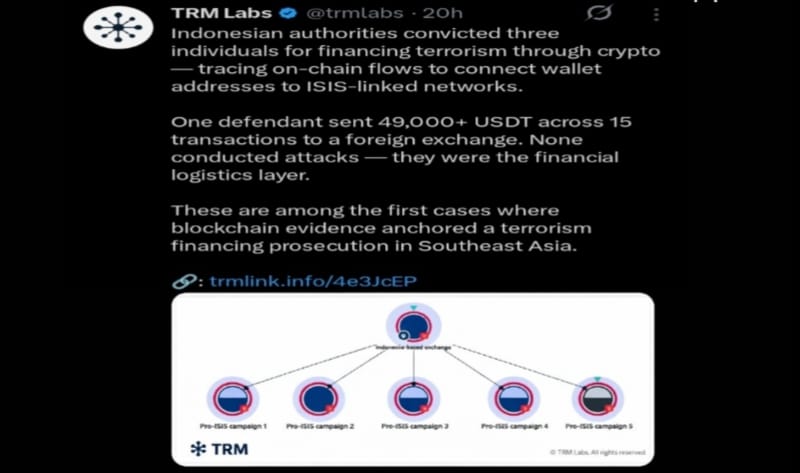
A Blockchain intelligence firm TRM Labs is calling a landmark shift for Southeast Asian law enforcement as an Indonesian court convicted three individuals for terrorism financing between 2024 and 2025 with wallet addresses, transaction histories, and on-chain fund flows serving as the prosecutorial spine of each case.
They didn't need informants or wiretaps and according to TRM Labs in a report published last Sunday, “Indonesian courts have demonstrated that cryptocurrency evidence, wallet addresses, transaction histories, and on-chain flows is not only admissible but can anchor a terrorism financing prosecution.”
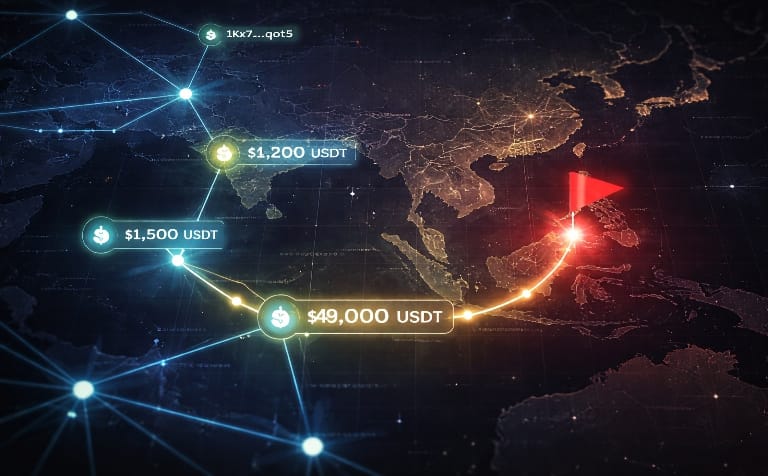
The details of at least one of the cases was shocking to the court body as authorities traced one defendant dispersing more than $49’000 worth of USDT across 15 separate transactions from a local Indonesian exchange to a foreign platform, with the funds ultimately routed to an ISIS-linked fundraising campaign operating out of Syria. The receipt and evidence was permanently engraved in the Blockchain.
The operation was a joint effort between PPATK, Indonesia's financial intelligence unit and Densus 88, the country's elite counterterrorism squad, formed in the wake of the 2002 Bali bombings and funded, trained, and equipped in partnership with the United States. Together, they observed the financial evidence of each case and walked Indonesian judges through Blockchain data point by point and the courts accepted every bit of it.
PPTAK’s SIPENDAR platform, a centralized database enabling real time information sharing between financial institutions and law enforcements gave Densus 88 the ability to access financial records and trace networks in actual real time. It is the kind of infrastructure and platform that clarifies any suspicious transaction.
What makes this more than a regional law enforcement story is the precedent it sets. For years crypto's critics argued that digital assets were little more than a financial getaway for those who were smart. Its defenders countered that the blockchain transparency actually makes illicit activity more traceable than cash transactions, and the Indonesian courts just confirmed the latter's defense.
TRM Labs isn't treating this as an isolated win. The firm describes these cases as part of a bigger regional repositioning, in which terrorist cells are increasingly using cryptocurrency to move funds across borders to evade traditional financial monitoring, a pattern TRM has tracked across multiple jurisdictions. The difference now is that governments are now noticing the trend.
Across Singapore, Malaysia, and Indonesia, regional financial intelligence units and law enforcement agencies are building the technical capacity to trace virtual assets and share financial intelligence in real time to construct prosecution ready cases.
The timing is also important. With Al-Hol camp in Syria which is held by ISIS family members recently closed, continued monitoring of terrorism financing campaigns is now considered critical by regional security analysts, as displaced networks seek new funding channels and communication pathways.
And if the financiers need any further discouragement: TRM Labs reported in February that illicit entities received approximately $141 billion worth of stablecoins in 2025, marking a five-year high. The scale of the problem is growing. But so, evidently, is the ability to chase it on-chain.
The message from the Indonesian Jarkata courtroom just set a precedent for all other regional financial institutions to follow.