Why Companies are Accumulating ETH in 2026?
In June 2025, a Nasdaq-listed sports betting company, SharpLink Gaming held a board meeting and the outcome had nothing to do with sports. The company had decided to shift its treasury strategy towards Ethereum and brought in Joseph Lubin, one of Ethereum co-founders, as chairman. When the news reached the market, stocks skyrocketed but overtime the hype around it died, but it was all part of a strategic move.

Making Ethereum their primary financial asset, they did so publicly for any investor in the world to participate in and over the same period, more companies, some crypto native, some not, started increasing their exposure to Ethereum. Some companies allocated new funds, changed balance sheets and what would've looked too extreme in the previous years was now the new normal and by the end of 2025 it was clear both to institutions and the general market that Ethereum is valuable to hold for the long term.
Why Companies And Institutions Avoided Ethereum For Years
To understand what's happening with Ethereum right now, it's important to understand what it was originally built to do and why it took so long for institutions to make investments. Ethereum launched in 2015 as a programmable blockchain. It gave developers a way to write code that runs directly on the network, codes that could build entire financial systems like lending platforms, payment systems, and automated contracts that execute on their own, without a central company in between. Over time, that became the foundation for what we now call DeFi, and later, the infrastructure behind stablecoins and tokenized assets. But the flexibility came with its own conditions.
Ethereum was a system that was constantly evolving, technically demanding and for a long time unclear from a regulatory standpoint. Questions around custody, classification, and taxation weren't fully settled so for institutions managing large pools of capital, that kind of uncertainty made it difficult to justify exposure.
Things changed in 2024 with the U.S regulatory approval of spot Ethereum ETFs, which gave investors a more familiar and compliant way to access the asset. Then in 2025, as regulatory clarity improved around custody and stablecoins, most of these uncertainties and legal barriers began to fade, and once that started, capital began to flow in.
What Changed Between 2024 And 2025
After the SharpLink collaboration was announced, within a few months another company took things even further, Bitmime Immersion Technologies, originally known as a Bitcoin mining firm made a decision to reposition itself around Ethereum. Led by Tom Lee, the Fundstrat founder and one of Wall Street most recognized marketing strategists. Under his direction Bitmine began accumulating Ethereum, building an ETH position at a steady pace week after week.
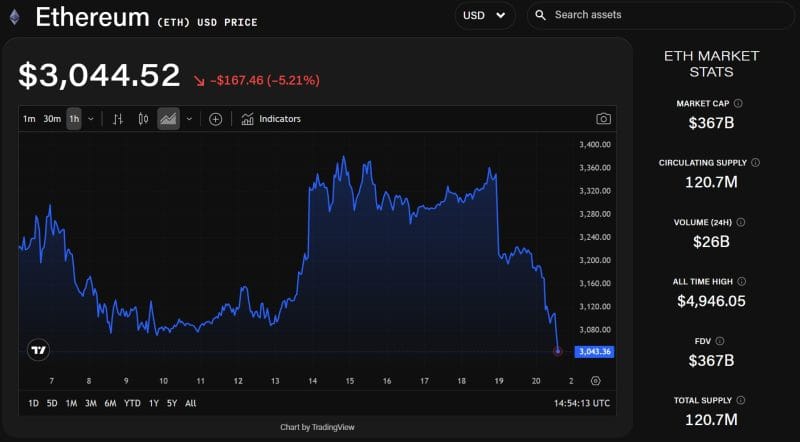
By early 2026, Bitmine had accumulated one of the largest known corporate Ethereum holdings, approximately 3.81% of Ethereum's entire circulating supply of 120.7 million tokens placing it among the most skilled treasury strategies in the market, ranking as the number two global crypto treasury company behind only Strategy the firm built on Michael Saylor's Bitcoin accumulation playbook which holds 738,731 BTC valued at $53 billion.
The Bitmine approach seemed deliberate as the goal was to raise capital, convert it into ETH, and continue accumulation regardless of short-term price movements. The model closely replicates what Michael Saylor did with Bitcoin but with a distinct difference. A large portion of Bitmine’s holdings is staked, generating approximately $180 million in annualized staking revenue, meaning it wasn't just about holding an appreciating asset, but also producing income from it, which was what made the Ethereum treasury strategy structurally different.
SharpLink on the other hand continued to build up its own position, after its initial pivot, the company raised an additional capital and expanded its Ethereum holdings, bringing its total holdings to 859,853 ETH with staking rewards adding incrementally to its balance over time.
These aren't the only companies moving in this direction, but they are among the obvious examples of something new taking its form, a group of firms structuring themselves around Ethereum. Eighteen months ago this category did not exist.
Ethereum vs Bitcoin As a Treasury Asset
The more important question isn't just who is buying but rather why Ethereum? And what does this mean for the broader market? Bitcoin has a clear narrative, it is digital gold with fixed supply, no yield or programmability, but more of scarcity and security. When companies like Tesla or even the government put Bitcoin on their balance sheet, the argument is straightforward as it is a store-of-value asset, but Ethereum is something you can put to work not just holdings, through staking it generates yield by participating in the network validation process. That alone changes how the asset is framed at an institutional level. A company holding ETH is not only making a long-term bet on price appreciation but holding an asset that has the ability to generate more yield by just holding.
In practice, this changes how the asset is presented to CFOs, treasury managers and investment committees. A yield bearing asset introduces a different kind of justification that sits between a commodity and financial investment, and the supply dynamic becomes more relevant in scale. When large holders stake meaningful amounts of ETH, that supply is effectively removed from active circulation for as long as it remains locked. When multiple treasury-style buyers accumulate and stake at the same time, the amount of freely available ETH in the market begins to tighten. This doesn't guarantee a price increase but changes the structure of supply and liquidity, which is what makes the current moment more significant because it shows how these buyers behave under pressure.
Through early 2026, some of the largest Ethereum treasury positions were hit with substantial unrealized losses as ETH pulled back. In some cases, those losses were measured in billions and even acknowledged publicly and yet accumulation continued.
Tom Lee described the current period as the final stages of a "mini crypto winter" and characterized the acceleration of purchases as deliberate. That is not the behavior of a trader looking for a short-term return. That is the behavior of a firm that has made a long-term structural bet and is treating price dips as accumulation opportunities.This confirmed it's long-term holding position as the drawdown was not treated as a signal to exit but opportunity to add.
What Staking Does to Supply And Market Structure
On a broader impact the treasury accumulation is just one layer compared to Ethereum’s position in the financial system. Geoff Kendrick, Standard Chartered’s head of digital assets research, recently pointed out that even with weaker performance across crypto markets, Ethereum's relative position has been improving and the bank expects the ETH-BTC ratio to gradually return to its 2021 highs because of how demand is evolving, and part of that comes down to who is still buying.

While corporate treasury interest is not as high in other areas of the market, Ethereum-focused accumulation has remained relatively consistent, and that type of demand even in less favorable conditions begins to matter over time.
The bank also highlighted Ethereum's structural position in stablecoins and real-world asset tokenization as long-term demand drivers that are independent of market sentiments and fluctuations. More than half of all stablecoins operate on Ethereum, generating roughly 40% of all Blockchain fees, which reinforces the network’s role as the primary settlement layer for dollar dominated blockchain transactions.
This matters because it means Ethereum institutional case is being built in two separate foundations at once, first they are financial products that use ETH as a treasury asset, and second, they are an infrastructure that uses Ethereum as an operating platform. Both are growing and the companies building on Ethereum as infrastructure, either for stablecoins, tokenized funds, or payment systems have their own reasons to want the network to remain dominant. That interest exists independently of price, which gives the ecosystem a degree of stability that purely speculative demand does not provide.
The appointment of Joseph Chalom, a former BlackRock managing director who led the firm's digital assets strategy,. including pioneering of IBIT and ETHA as CEO of SharpLink in December 2025 explains exactly how deep these institutional connections now run. The people who built BlackRock's crypto products are now running Ethereum treasury companies and that is not a coincidence.
What's Next For Ethereum
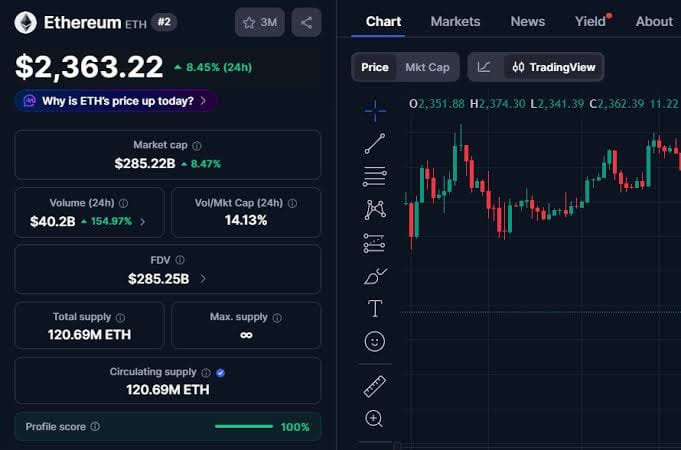
As of March 17, 2026, ETH is currently trading around $2360, still well below its all time high of $4951 reached on August 24, 2025. The institutional dominance has not yet shown up in price recovery, and this matters because on one side, you have steady accumulation, institutional positioning and a growing role in financial infrastructure. On the other, a market that hasn't fully repriced any of it. This reflects the tension between the two realities and where Ethereum sits right now.
Standard Chartered's Geoff Kendrick forecasts ETH reaching $7500 in 2026, rising to $15,000 by the end of 2027, $22,000 by the end of 2028, and even $30,000 by 2029 with a longer target of $40,000 by 2030. The bank ties these projections specifically to the dominance of Ethereum on stablecoins and tokenized assets, and also the continued accumulation by treasury companies and institutions. More moderate forecasts from traditional finance cluster between $4000-$6000 range for 2026, with contingent steady on macro conditions and sustained ecosystem growth without major increase on the institutional side.
On the other hand the bearish case is also harder to ignore, Analyst Benjamin Cowen has argued that Ethereum may struggle to break into new highs this cycle, pointing to Bitcoin continued dominance and broader liquidity problems. His view isn't that Ethereum fails but rather that its upside in this cycle could be lower than the bullish predictions suggest.
Despite the differences in price targets, there is a point of agreement. The long-term case for Ethereum is no longer built on retail speculations or developer narratives but rather, tied to how much capital can be willingly committed and how consistent it can be.
Some of the largest positions in the market have continued to build even through drawdowns. Companies are staking what they hold. Institutions are publishing forward projections. The behavior looks less like short-term positioning and more like capital being deployed with a longer horizon in mind. What the market hasn’t decided yet is how quickly that conviction translates into price, and whether that repricing happens within this cycle or become the foundation for the next cycle is still an open question.
In our next article, we will examine the stablecoin market, who dominates it and how it affects general market predictions and speculations on stablecoins.
Delogg Media