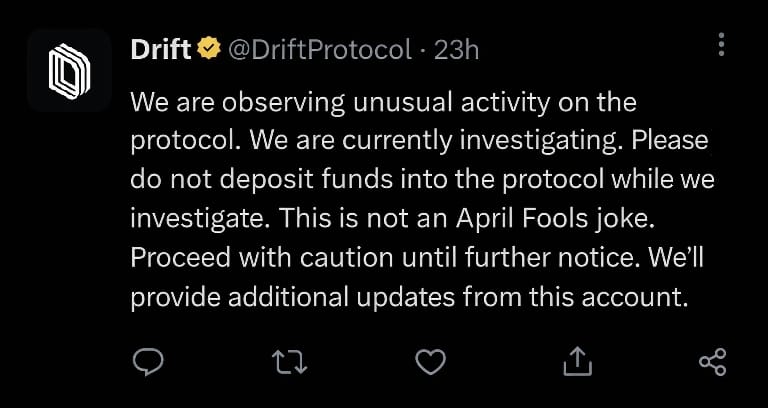
When blockchain security firm PeckShield flagged unusual outflows from Drift Protocol on April 1, many users assumed it was a prank. The Drift team was forced to address the confusion head-on, posting on X that this was "not an April Fool's joke" and urging users to stop interacting with the protocol immediately. It wasn't a joke. It was the largest DeFi exploit of 2026.
An attacker drained $285 million from Drift Protocol, the Solana-based perpetual futures exchange, collapsing its total value locked from over $550 million to roughly $24 million within hours. The DRIFT token dropped more than 20% in the immediate aftermath.
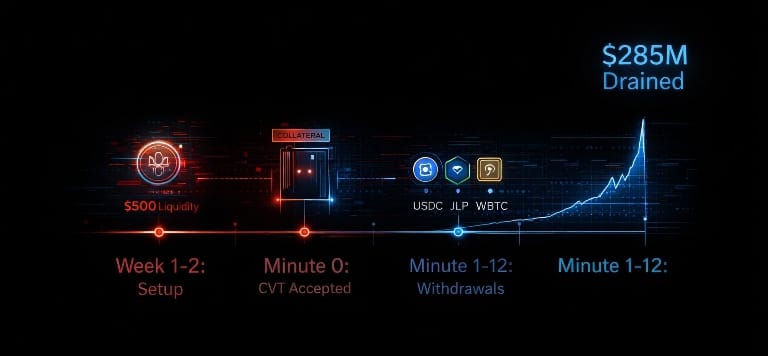
A Weeks-Long Setup, a 12-Minute Drain
The attack was not a smart contract vulnerability but a coordinated operational security failure leveraging durable nonce pre-signatures, social engineering of multisig signers, and a critically weak 2/5 Security Council configuration with zero timelock.
The preparation began weeks in advance. The attacker created a fake token called "CarbonVote Token" (CVT), minting 750 million units and seeding a liquidity pool on Raydium with just $500. Wash trading artificially inflated the token's price until on-chain oracles began reporting it as legitimate.
With a compromised admin key, the attacker listed CVT as valid collateral on Drift, removed all withdrawal limits, and executed 31 rapid withdrawals draining USDC, JLP, WBTC, and other real assets in approximately 12 minutes.
Drift confirmed no smart contract bug was exploited and no seed phrases were stolen, describing the incident instead as a targeted administrative takeover. Security audits by Trail of Bits in 2022 and ClawSecure in February 2026 had both cleared the protocol, but the CVT market introduction and recent governance changes slipped through the cracks.
The hack is the second-largest security event in Solana's history, behind only the $326 million Wormhole bridge exploit in 2022, and by far the largest DeFi exploit of 2026.
Circle Under Fire
As details of the exploit emerged, a second controversy ignited this one aimed at Circle, the issuer of USDC.
According to on-chain investigator ZachXBT, stolen USDC was bridged from Solana to Ethereum via Circle's Cross-Chain Transfer Protocol across more than 100 transactions over approximately six hours all during U.S. business hours with zero intervention from Circle.
The timing made it worse. Just days before the Drift exploit, Circle had frozen USDC balances across 16 unrelated business hot wallets as part of a sealed U.S. civil case, disrupting operations for exchanges, casinos, and payment processors.
ZachXBT contrasted Circle's aggressive response in that civil matter with its inaction during a confirmed nine-figure exploit, arguing that Circle had both the ability and the precedent to intervene but failed to act in time. Security researcher Specter noted the attacker deliberately avoided converting funds to Tether during the bridging process, a sign they were confident Circle would not act. Circle has not issued a public statement at the time of publication
Ripple Effects Across Solana
The fallout spread quickly. Ranger Finance halted deposits and withdrawals with exposure estimated at over $900,000. Project 0 stopped borrowing against Drift positions. Platforms including TradeNeutral, GetPyra, and Elemental DeFi paused key features. Jupiter Exchange confirmed its JLP pool remains fully backed.
Drift, co-founded by Cindy Leow and David Lu, had raised over $52 million in venture funding from Multicoin Capital, Polychain Capital, and Jump Capital. The protocol has paused all operations while coordinating with law enforcement and security partners.
Earlier in 2026, crypto hacks had already drained $112.5 million across the first two months of the year. The Drift exploit alone now dwarfs that figure several times over.