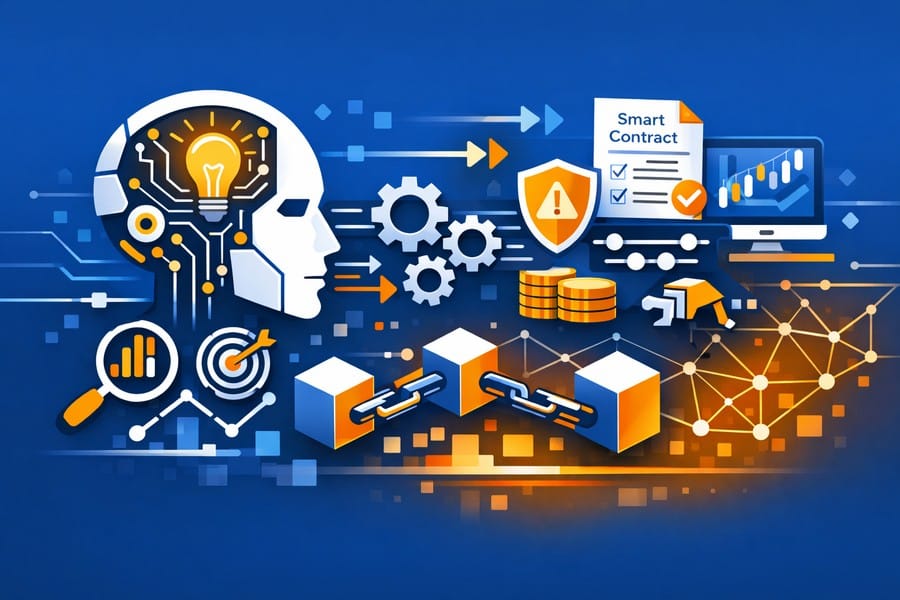
Artificial Intelligence and Blockchain are often discussed as if they belong to separate worlds — one focused on cognition and automation, the other on decentralization and trust. But when these two technologies intersect, something far more powerful emerges: systems that can think, verify, and operate without centralized control.
This relationship isn’t theoretical anymore. It’s already reshaping finance, identity, security, and the way digital value moves across the internet.
1. AI Needs Trust — Blockchain Provides It
AI models are becoming more capable, but also more opaque in a sense that we rarely know how they reach decisions, what data they were trained on, or whether outputs have been tampered with.
Blockchain introduces:
- Immutable audit trails
- Verifiable data provenance
- Decentralized execution environments
- Tamper‑proof model outputs
Together, they create AI systems that are not only powerful — but trustworthy.
2. Blockchain Needs Intelligence — AI Delivers It
Blockchains are secure but rigid. They follow rules perfectly, but they don’t adapt or learn.
AI fills that gap by enabling:
- Smart contract optimization
- Predictive analytics for DeFi
- Fraud detection and anomaly spotting
- Automated governance and parameter tuning
This transforms blockchains from static ledgers into dynamic, self‑improving ecosystems.
3. The Rise of Autonomous Economic Agents
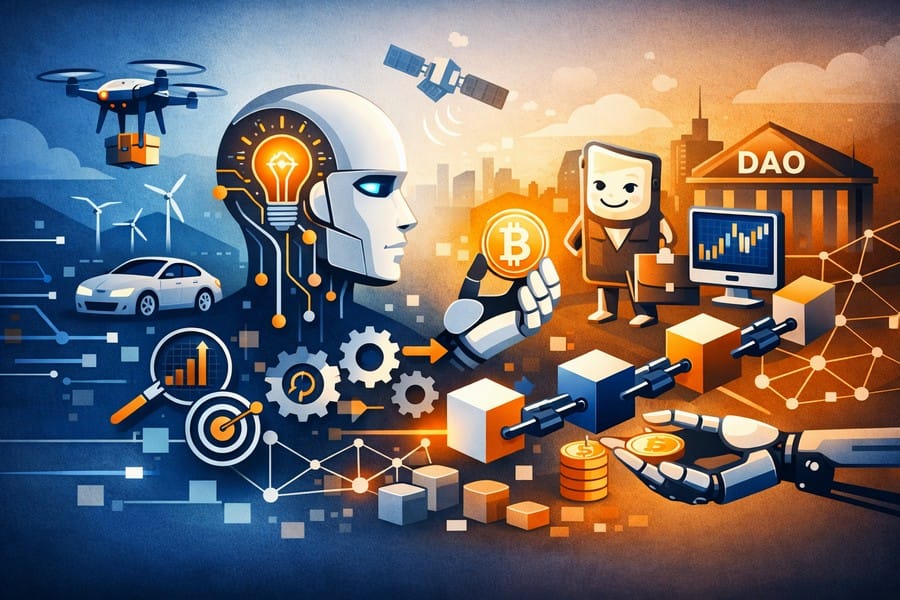
One of the most exciting outcomes of this relationship is the emergence of autonomous agents — AI systems that can hold crypto, execute transactions, and interact with smart contracts.
Imagine:
- AI bots that manage liquidity
- Autonomous DAOs that evolve over time
- AI‑driven marketplaces with no central operator
- Machine‑to‑machine payments on Bitcoin, Ethereum, or L2s
This is where AI and Blockchain stop being separate technologies and start becoming a new economic layer.
4. Real‑World Use Cases Already Emerging
Here are areas where the fusion is already happening:
- AI‑verified identity (zero‑knowledge proofs + biometrics)
- AI‑powered blockchain security (threat detection, MEV defense)
- Decentralized AI marketplaces (compute, models, datasets)
- On‑chain AI inference (WASM, EVM, and custom runtimes)
- Cross‑chain AI bridges (autonomous routing + risk scoring)
The infrastructure is still early, but the direction is clear.
5. What Comes Next?
The next decade will likely bring:
- AI‑native blockchains
- Self‑governing protocols
- On‑chain AI agents with economic autonomy
- Decentralized training and model ownership
- AI‑driven regulation and compliance automation
The relationship between AI and blockchain isn’t just complementary — it’s catalytic.